
BrooklynPain Clinic
Pain care that's easy to reach from Brooklyn, by train or by bridge.
Treatment takes place at Queens Pain Clinic, 9701 66th Ave, Rego Park, NY 11374. This page is for patients traveling from the Brooklyn area.
CALL NOW // PAIN CARE LINE1 877 97 NO PAINGetting here from Brooklyn
From North Brooklyn the trip is a G train ride to Long Island City, then a short hop on the Queens Boulevard line to Rego Park. From Fourth Avenue in south Brooklyn, one train does the whole job.
Williamsburg, Greenpoint, Bed-Stuy
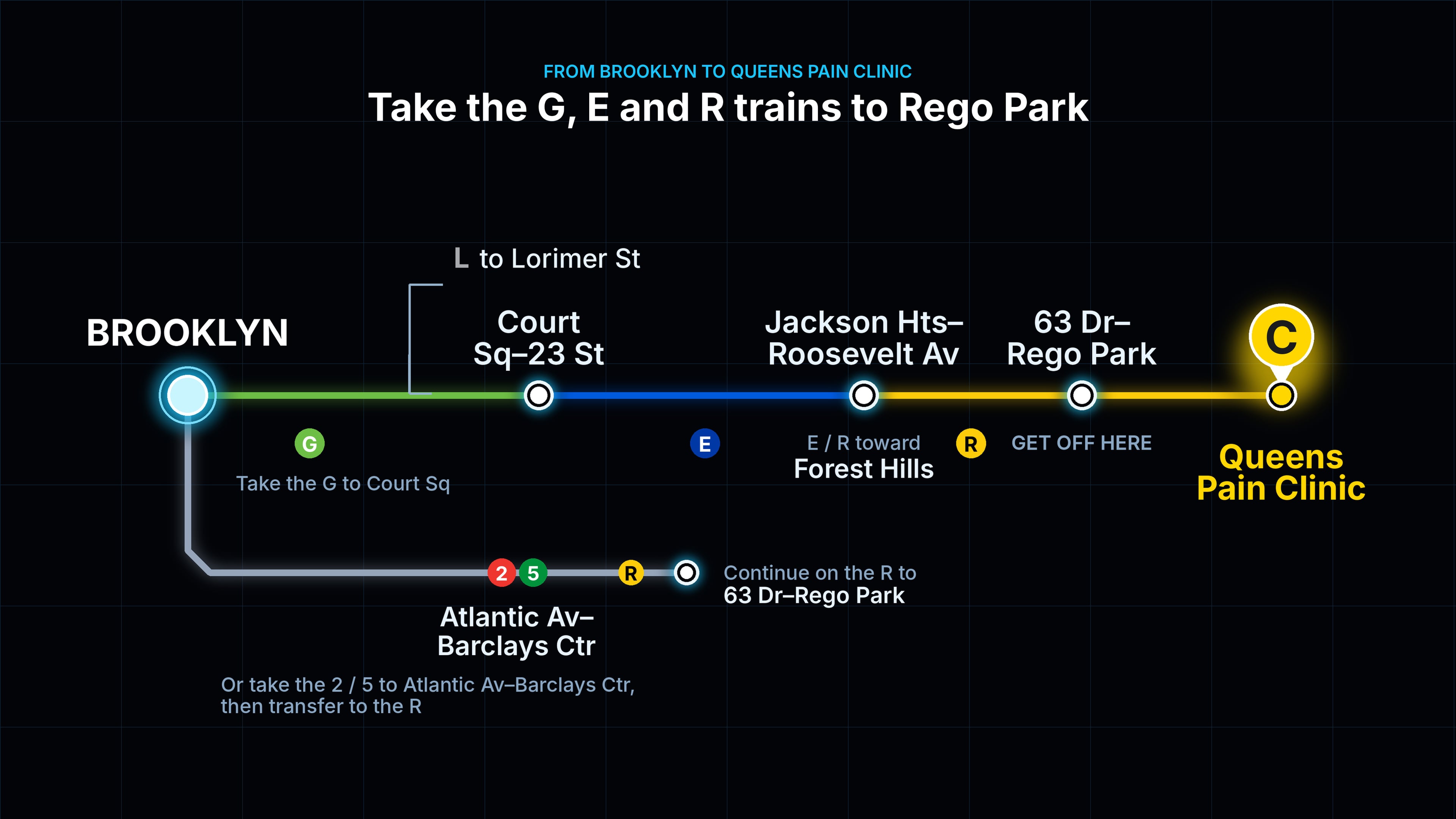
Take the G to Court Sq-23 St. Switch to the E toward Forest Hills, change at Jackson Hts-Roosevelt Av to the local R, and get off at 63 Dr-Rego Park. The 7 from Court Sq to Jackson Hts-Roosevelt Av also works.
Bushwick and Ridgewood
Take the L to Lorimer St, change to the G toward Court Sq, then follow the steps above.
Bay Ridge, Sunset Park and Park Slope
The R runs along Fourth Avenue and straight through Manhattan to Queens with no transfer. It's a long ride but a simple one.
Flatbush
Take the 2 or 5 to Atlantic Av-Barclays Ctr, then switch to the R toward Forest Hills-71 Av.
Good to know
Weekday daytime M service and late-night patterns differ from the R. Check the MTA trip planner for the day you're traveling.
Stairs
63 Dr-Rego Park has stairs and no elevator today. Call us if you need another plan.
Driving
Take the BQE (I-278) north across the Kosciuszko Bridge into Queens, then follow signs toward Queens Boulevard and the LIE. Drivers coming off the Williamsburg Bridge join the BQE north.
Schematic route, not to scale. Check the MTA trip planner for current service.
Brooklyn bodies, Brooklyn routines
People come to us from Williamsburg, Park Slope, Bay Ridge, Flatbush and nearby neighborhoods.
Brownstone stairs, bike lanes, studio floors, long shifts at a counter, a toddler on your hip. Brooklyn life is physical, and the pain that comes with it is usually a pattern, not a one-time event. We look at what you do all day, not just the spot that hurts.
We're open Sundays from 9 am to 3 pm, and until 6 pm on Monday, Tuesday, Thursday and Friday.
Conditions we treat
Bike, car and rideshare collisions on busy avenues.
Elbow strain from craft work, kitchen shifts, climbing and cycling.
Wrist pain from handlebars, studio tools, keyboards and carrying kids.
Hip pain from brownstone stairs, long walks and repetitive riding.
Knee pain from stairs, hills on the bike and laps around the park.
Back pain from hauling groceries and strollers up walk-ups.
Neck pain from workstations, laptops and phones.
Shoulder pain from reaching, lifting and bike falls.
Nerve-related burning pain after a break, sprain or surgery.
Tailbone pain after a fall, or after hours on a stool or studio chair.

Services and treatments
A real conversation, a careful exam and a plan built around your week.
Care after car, rideshare and bike collisions, with the records insurers ask for.
Thin needles used to relax tight muscles and support comfort during recovery.
Anti-inflammatory medicine delivered around pinched spinal nerves, often for sciatica.
Eases worn spinal joints that cause achy neck and back pain.
Digs into habits and health factors, like sleep and diet, that keep pain going.
Mild electrical pulses delivered to a specific nerve outside the spine.
Hands-on therapy and exercise to rebuild strength and get you moving.
A regenerative injection for ligament and tendon pain that hasn't settled.
Your own platelets, concentrated and placed in a joint or tendon to encourage repair.
Uses radio-wave heat on pain-carrying nerves for relief that can last months.
Treats irritation where your spine meets the pelvis.
A small implanted system that interrupts pain messages, tested first with a trial.
A range of precise injections guided by imaging.
Quick injections for the tender knots that make a shoulder or back feel locked.
Treatment for injuries from your job, with the documentation your claim needs.
Medicine placed next to a nerve to turn down pain and show us where it comes from.
Monitored infusions for certain long-lasting pain conditions that haven't responded to other care.
Learn more before you come in
PRP vs. Prolotherapy
Two regenerative options for tendon, ligament and joint pain. Here's how they differ.
See all comparisonsFrom the BlogStairs, bikes and brownstones
How everyday Brooklyn habits add up in your knees, hips and back.
Read the full blogKnowledge CatalogueRegenerative Treatments
What PRP and prolotherapy are, who they're for and what to expect.
Browse the knowledge catalogueResourcesPlan your first visit
Providers, new patient info, what to expect, payment options, insurance and online forms.
Visit ResourcesQuestions from patients in Brooklyn
This page is general information, not medical advice. Results vary from person to person. If you think you're having a medical emergency, call 911.