Sacroiliac Joint Injection in Queens, NY
Fluoroscopy-guided relief and answers for low back, buttock and pelvic pain.
A sacroiliac joint injection places a small dose of local anesthetic and corticosteroid into the SI joint, where the base of your spine meets your pelvis, under live X-ray (fluoroscopy).
The anesthetic response helps show whether this joint is the source of your pain. The steroid treats inflammation and may give you a window of less pain to strengthen with physical therapy. Queens Pain Clinic has treated pain in Queens since 2004.
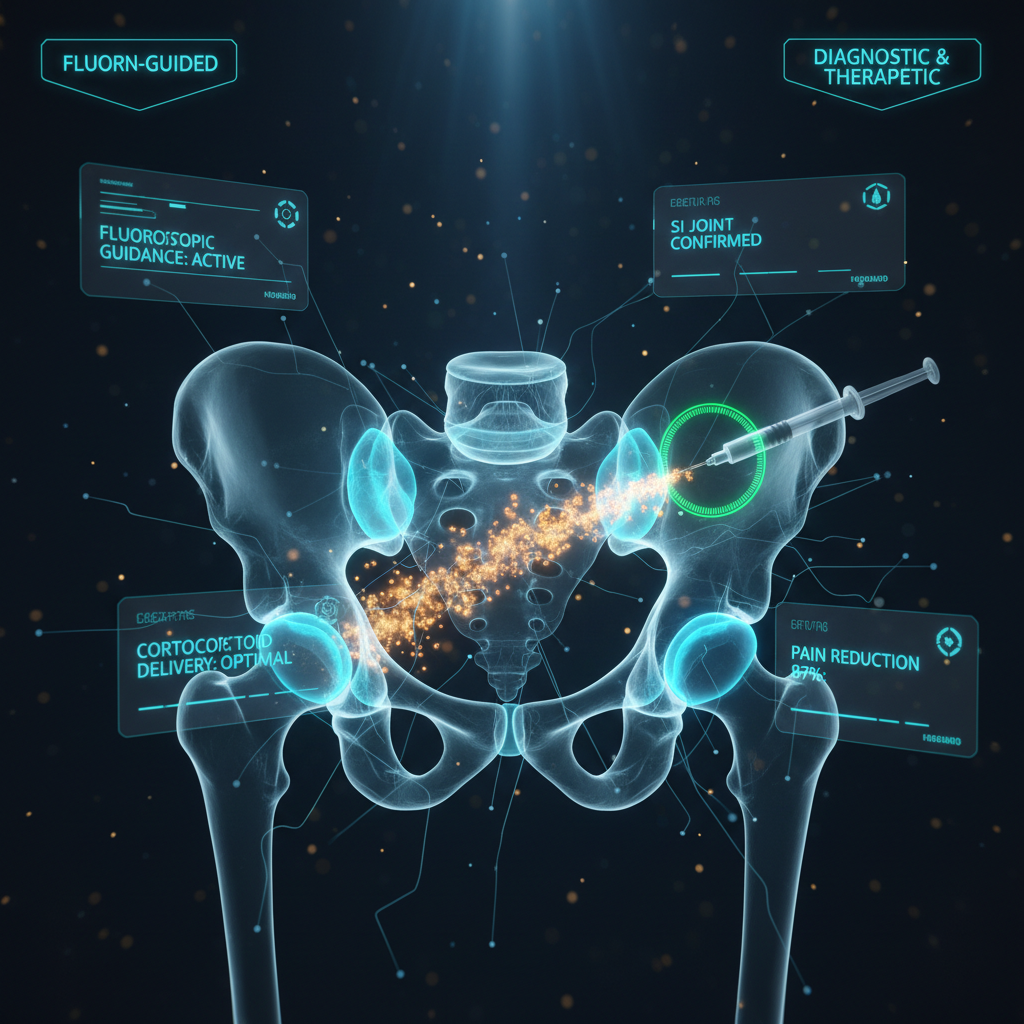
A sacroiliac (SI) joint injection puts a small dose of local anesthetic and corticosteroid into the joint where the base of your spine meets your pelvis, using live X-ray (fluoroscopy) for guidance. The anesthetic helps show whether the SI joint is the source of your pain. The steroid treats inflammation and may give you a window of less pain to strengthen with physical therapy. It is an outpatient procedure that takes about 15 to 20 minutes. Relief from the steroid is variable and ranges from weeks to several months.
Key Features
Conditions Addressed
Top Benefits
Low back, buttock and pelvic pain that comes from the SI joint
Outpatient. Local anesthetic only, no general anesthesia
About 15 to 20 minutes, within a longer clinic visit
Fluoroscopy (live X-ray), with contrast dye to confirm placement
Most people return to normal activity the next day
Varies from weeks to several months
9701 66th Ave, Rego Park, NY 11374
1-877-97 NO PAIN
What Is SI Joint Pain?
You have two SI joints. They link the sacrum, at the base of your spine, to your pelvis. Inflammation, degeneration, strain, injury or pregnancy can make them painful.
Estimates suggest SI joint pain accounts for 15 to 30 percent of chronic low back pain. It overlaps with disc problems, facet joint pain and sciatica, which is why the cause can be hard to pin down without a careful examination.
- One-sided pain below the belt line
- Pain that can spread to the buttock, groin or back of the thigh
- Pain that worsens when standing up from a chair
- Pain on stairs or when rolling over in bed
- Pain when standing on one leg
After the injection, we ask you to repeat the movements that normally hurt and to track your pain for several hours. A substantial drop, commonly half or more, supports the SI joint as the source. Little or no change points us to look elsewhere.
What We Use SI Joint Injections For
These are the conditions we evaluate for an SI joint injection after an examination and imaging review.
SI joint dysfunction
Pain that comes from irregular movement or strain in the joint between the sacrum and pelvis.
Sacroiliitis
Inflammation of the SI joint.
Degenerative sacroiliitis
Wear and arthritis of the joint over time.
Ankylosing spondylitis and other spondyloarthritis
Inflammatory arthritis that involves the SI joints. Your rheumatologist stays responsible for your overall treatment.
Pelvic girdle pain after pregnancy
Pain around the pelvis and SI joints that continues after delivery.
Pain after a fall or car accident
Joint pain that follows an injury. Auto accident patients can also see our auto injury care.
Pain after spinal fusion or back surgery
SI joint pain is reported in roughly 32 to 37 percent of people with ongoing pain after lumbosacral fusion.
Buttock and hip-area pain
Pain sometimes first labeled piriformis syndrome that turns out to come from the SI joint.
What Happens During the Injection
Five steps, from check-in to going home the same day.
Check-in and review
We review your medications, allergies, blood thinners and possible pregnancy before anything starts.
Positioning and numbing
You lie face down. The skin is cleaned and numbed with local anesthetic.
Fluoroscopic guidance
Using live X-ray, the physician guides the needle into the joint. Contrast dye confirms the medicine will spread inside the joint.
Injection
Local anesthetic and corticosteroid are injected into the SI joint. You may feel pressure or a brief flare of your familiar pain.
Observation and aftercare
After a brief observation, we check your pain and review aftercare. Plan for a longer visit than the 15 to 20 minute procedure, and arrange a ride if you can because your leg may feel heavy.
What Relief Looks Like, Honestly
Steroid relief is variable and often short-term. Here is the usual pattern.
The anesthetic may numb the joint. This helps show whether the SI joint is the pain source.
The corticosteroid commonly takes days to begin working.
Steroid benefit may begin within days and peak in the first one to two weeks.
Relief often lasts several weeks to a few months. It varies, and some people get little benefit.
The evidence for therapeutic SI joint injections is fair (Level III). Short-term relief is more likely than long-term relief. This is not a strong, first-line treatment backed by firm guidelines.
A single positive response is not definitive because false positives occur. Many physicians look for a second confirming block before radiofrequency ablation.
If the diagnosis is solid, radiofrequency ablation is a possible longer-lasting option. A 2024 meta-analysis found better and longer pain relief than steroid injections for facet and SI joint pain. A 2026 clinical review estimates roughly 6 to 12 months of durable relief in well-selected patients.
Minimally invasive SI joint stabilization may be considered for structural instability.
Who Is a Good Candidate?
- Pain over the SI joint lasting more than a few weeks
- Not enough improvement with medication, rest and physical therapy
- A hands-on examination and several positive SI provocation tests
- Imaging that helps rule out other causes of the pain
- Possible pregnancy, because X-rays are used
- Active infection or fever
- Blood thinners
- Diabetes, because steroids may raise blood sugar for several days
- Past reactions to contrast dye, local anesthetics or steroids
These factors may change the plan rather than automatically rule out treatment.
Risks, Aftercare and Repeat Injections
Injection-site soreness, temporary leg numbness or heaviness, a brief pain flare, facial flushing, trouble sleeping, or higher blood sugar after steroids.
Infection, bleeding, allergic reaction and nerve irritation. Your physician will review your individual risks before you decide.
Fever, severe or worsening pain, new leg weakness, loss of bladder or bowel control, or spreading redness or swelling at the injection site.
Take it easy for the rest of the day. Most people return to work and normal routines the next day. Avoid hot tubs and baths for a day or two, and ease back into exercise.
Keep a simple two-week pain diary. Note your pain during the first six hours, then daily, including movements that still hurt. Pair the injection with physical therapy while pain is quieter so pelvic-stabilizing exercises can work.
We repeat a steroid injection only when the previous one clearly helped and your physician considers another worthwhile. Steroid effects are cumulative, so the number per year is limited and set by your physician.
SI Joint Pain vs. Disc and Facet Pain
| Feature | SI joint pain | Disc or facet pain |
|---|---|---|
| Typical location | Low and one-sided, below the belt line. Sometimes the buttock or groin | Disc pain is often below the knee and worse bending forward. Facet pain is often worse leaning backward |
| How we tell | Examination, provocation tests and a diagnostic injection | Examination and imaging, with overlap between causes |
Causes overlap, so the examination matters. If you were hurt in a crash, see our auto injury care. You can also read about low back pain.
Queens Pain Clinic has treated pain in Queens since 2004. Your first step is an examination and imaging review so we can decide together whether an SI joint injection makes sense.
Phone: 1-877-97 NO PAIN
These pages may also help.
Sacroiliac Joint Injection: Common Questions
Ask Whether Your Pain Is Coming From the SI Joint
If low back, buttock or pelvic pain has lasted more than a few weeks, come in for an examination and imaging review. We will tell you plainly whether an SI joint injection makes sense or whether another approach would serve you better.
9701 66th Ave, Rego Park, NY 11374
Phone: 1-877-97 NO PAIN
Treating pain in Queens since 2004.
- Monday9:00 am to 6:00 pm
- Tuesday9:00 am to 6:00 pm
- WednesdayClosed
- Thursday9:00 am to 6:00 pm
- Friday9:00 am to 6:00 pm
- SaturdayClosed
- Sunday9:00 am to 3:00 pm
This page is for general information and is not medical advice. Results vary from person to person. Talk with a qualified physician before starting treatment.