Prolotherapy in Queens, NY
Dextrose injections for stubborn ligament, tendon and joint pain, from board-certified pain specialists in Rego Park.
Prolotherapy is an injection treatment for chronic musculoskeletal pain. A physician places a dextrose (sugar) solution into or around a painful ligament, tendon or joint, with the aim of prompting the body to repair that tissue. Most patients need a short series of visits rather than a single shot.
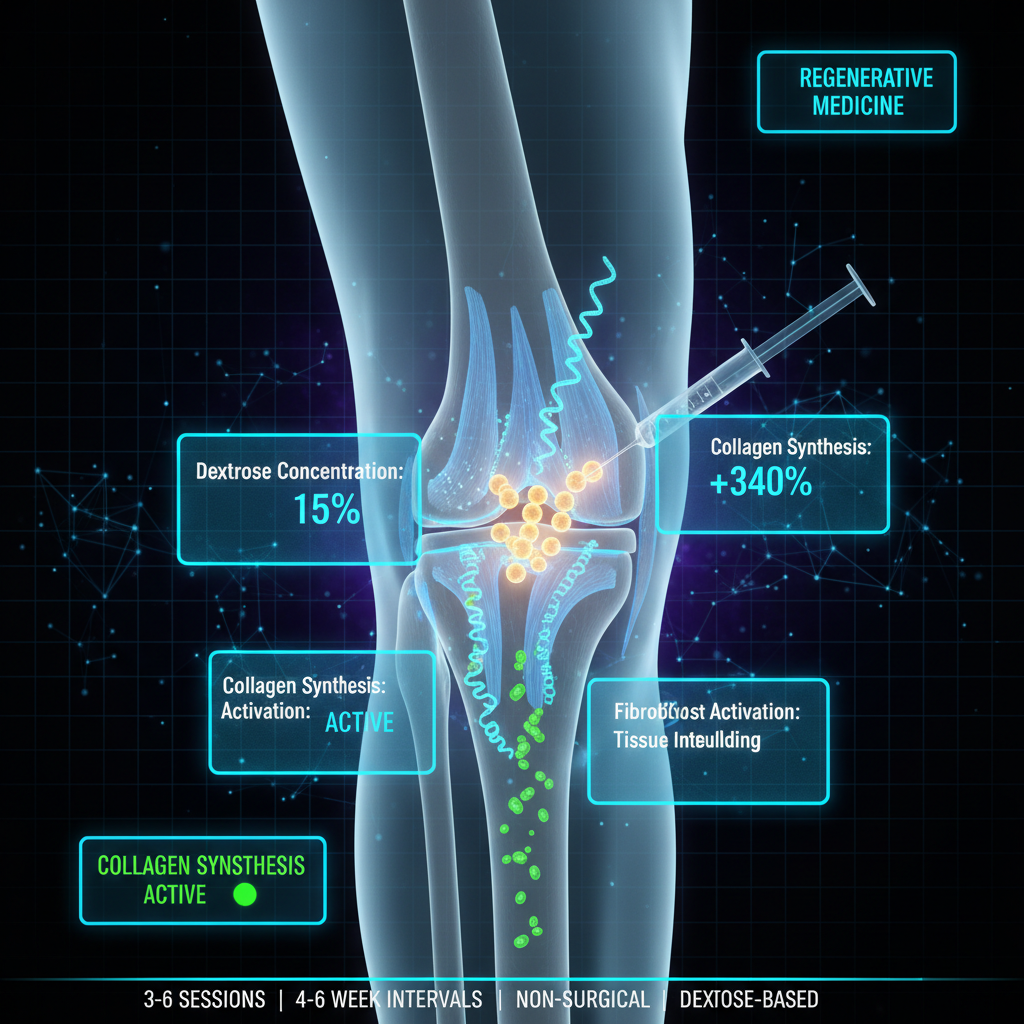
Prolotherapy is an injection treatment for chronic musculoskeletal pain. A physician places a dextrose (sugar) solution into or around a painful ligament, tendon or joint, with the aim of prompting the body to repair that tissue. At Queens Pain Clinic we use it mostly for knee osteoarthritis, tendon problems and pain tied to loose, overworked ligaments, usually alongside physical therapy. Most patients need a short series of visits rather than a single shot, and improvement tends to build gradually over weeks to months.
Key Features
Conditions Addressed
Top Benefits
Dextrose solution, often mixed with a local anesthetic
Ultrasound, so the needle reaches the right structure
About 30 to 45 minutes
3 to 6 sessions, 4 to 6 weeks apart
Local only. No sedation or surgery
Most people resume light activity the same day
Usually self-pay. See the cost section below
9701 66th Ave, Rego Park, NY 11374
How Does Prolotherapy Work?
The dextrose in a prolotherapy injection is more concentrated than the sugar level in your body's tissues. That difference irritates the injection site mildly and briefly. The leading explanation is that this irritation switches on the same repair process the body uses after a minor injury: growth factors are released, repair cells called fibroblasts arrive, and they lay down new collagen, the protein ligaments and tendons are built from.
It helps to be straight about the limits of that explanation. It is the working theory, and researchers are still sorting out exactly why patients improve. What the clinical trials do show, in certain conditions, is that people who get dextrose injections report less pain and better function than people who get saline or exercise alone. The next section says which conditions have that support and which do not.
Brief, mild irritation at the injection site may trigger growth factor release, bring in fibroblasts and prompt new collagen. This is the leading explanation, not settled fact.
In certain conditions, people who receive dextrose injections report less pain and better function than people who receive saline or exercise alone.
What Conditions Can Prolotherapy Treat?
Prolotherapy has the best research behind it for knee osteoarthritis and for certain tendon problems. For other areas the evidence is thinner, and we tell patients that up front.
Knee osteoarthritis
Strongest evidenceThe strongest evidence. In a blinded trial of 90 adults, dextrose injections improved pain, function and stiffness at 52 weeks compared with saline injections or home exercise. A second blinded trial in Hong Kong also found less pain than with saline.
A reasonable option when pain has lasted months and standard care has not been enough.
Tendon pain (tennis elbow, Achilles)
PromisingA review of randomized trials in sports-related tendinopathy found most studies favored prolotherapy, though the authors called the results promising rather than proven. Trials are small and methods vary.
Often paired with a loading or strengthening program.
Shoulder, hip, ankle, sacroiliac joint, TMJ, neck
Limited evidenceMostly small studies and clinical experience. One recent analysis found prolotherapy no better than control for rotator cuff tendinopathy.
Offered after an exam when other treatment has not worked, with realistic expectations.
Chronic low back pain
Not aloneReviews, including a Cochrane review, found prolotherapy alone is not an effective treatment. It may help when combined with exercise and other therapy.
Part of a broader plan, never the only treatment.
We also evaluate plantar fasciitis, chronic ankle sprains and lingering pelvic or tailbone ligament pain. If an injection is not the right tool for your problem, we will say so.
Is Prolotherapy Right for You?
- Pain that has lasted three months or longer
- An exam or imaging that points to a ligament, tendon or joint as the source
- Little progress with rest, physical therapy or medication
- A wish to avoid repeated steroid injections, or to delay surgery
- An active infection near the injection site
- Blood thinners
- Diabetes
- Pregnancy, or possible pregnancy
- A past reaction to a local anesthetic
None of these automatically rules you out, but they change how we plan.
What to Expect During Treatment
Five steps, from your first exam to follow-up visits spaced over several weeks.
Evaluation
Your physician examines the painful area, goes over any imaging and asks what you have already tried. Not everyone who comes in for prolotherapy gets it, and that is by design.
Planning
If it fits, we decide which ligaments, tendons or joint spaces to treat and how many injection sites that involves. Several sites can be treated in one visit.
Injection
The skin is cleaned, a local anesthetic is used where appropriate, and the dextrose is placed under ultrasound guidance through a series of small injections. The appointment runs about 30 to 45 minutes.
Afterward
Expect soreness, stiffness or mild swelling for a few days. Most people go back to light activity that day. Check with us before taking ibuprofen or naproxen, and we will tell you what to use for pain instead.
Follow-up
Sessions are usually 4 to 6 weeks apart, and most people have 3 to 6. Improvement tends to be gradual, building over weeks to months, not overnight.
Soreness, stiffness, bruising and swelling at the injection site, usually settling within a few days.
Infection, bleeding, nerve irritation and allergic reaction to the anesthetic.
Because prolotherapy uses dextrose rather than a steroid, it does not carry steroid-specific risks such as elevated blood sugar or tissue thinning.
Your physician will go through the risks that apply to you before you decide.
Prolotherapy vs. Cortisone vs. PRP
| Feature | Prolotherapy | Cortisone injection | PRP |
|---|---|---|---|
| What's injected | Dextrose solution | Corticosteroid | Platelets concentrated from your own blood |
| Goal | Prompt tissue repair | Reduce inflammation and pain | Prompt tissue repair |
| Speed of relief | Gradual, over weeks | Often fast, often temporary | Gradual, over weeks |
| Main drawback | Several visits; evidence varies by condition | Repeated doses may weaken tendon and cartilage | Costs more; needs a blood draw |
No one of these is best for everyone. Which fits depends on the tissue involved and how long you have had the problem. If PRP or another option suits your case better, we will recommend it. See our PRP page for details.
Most insurance plans do not cover prolotherapy, because many insurers still classify it as investigational.
Our billing team can explain what to expect and which payment options are available before you commit to a course of treatment. See Payment Options or call 1-877-97 NO PAIN.
Prolotherapy is usually used alongside physical therapy. These pages may also help.
Prolotherapy FAQs
Ready to Find Out If Prolotherapy Fits?
A consultation is the first step. Your physician will look at your pain, your imaging and your history, then tell you honestly whether prolotherapy, another injection or a different approach makes the most sense.
9701 66th Ave, Rego Park, NY 11374
Phone: 1-877-97 NO PAIN
Board-certified interventional pain specialists serving Queens since 2004.
- Monday9:00 am to 6:00 pm
- Tuesday9:00 am to 6:00 pm
- WednesdayClosed
- Thursday9:00 am to 6:00 pm
- Friday9:00 am to 6:00 pm
- SaturdayClosed
- Sunday9:00 am to 3:00 pm
- Rabago et al., Dextrose Prolotherapy for Knee Osteoarthritis: A Randomized Controlled Trial, Annals of Family Medicine, 2013
- Efficacy of Intra-Articular Hypertonic Dextrose (Prolotherapy) for Knee Osteoarthritis: A Randomized Controlled Trial, Annals of Family Medicine, 2020
- Prolotherapy in the Treatment of Sports-Related Tendinopathies: A Systematic Review of Randomized Controlled Trials, Orthopaedic Journal of Sports Medicine
- Prolotherapy for rotator cuff tendinopathy: systematic review and meta-analysis
- Prolotherapy: Can it help your patient? Journal of Family Practice
- Medical policy summary of Cochrane (Dagenais 2007) and related reviews on low back pain
This page is for general information and is not medical advice. Results vary from person to person. Talk with a qualified clinician before starting a new treatment.